
There’s a question worth sitting with after reading Adam Fein’s latest post on PSG’s rebate data: if nearly half of employers can’t confirm they’re getting 100% of their specialty drug rebates, why are we still treating the negotiation itself as the savings strategy? This is the first post in a 3-part series exploring how PBMs’ pricing conflicts aren’t a glitch in the system – they’re the architecture – and how clinical efficacy can help employers manage the resulting spend.
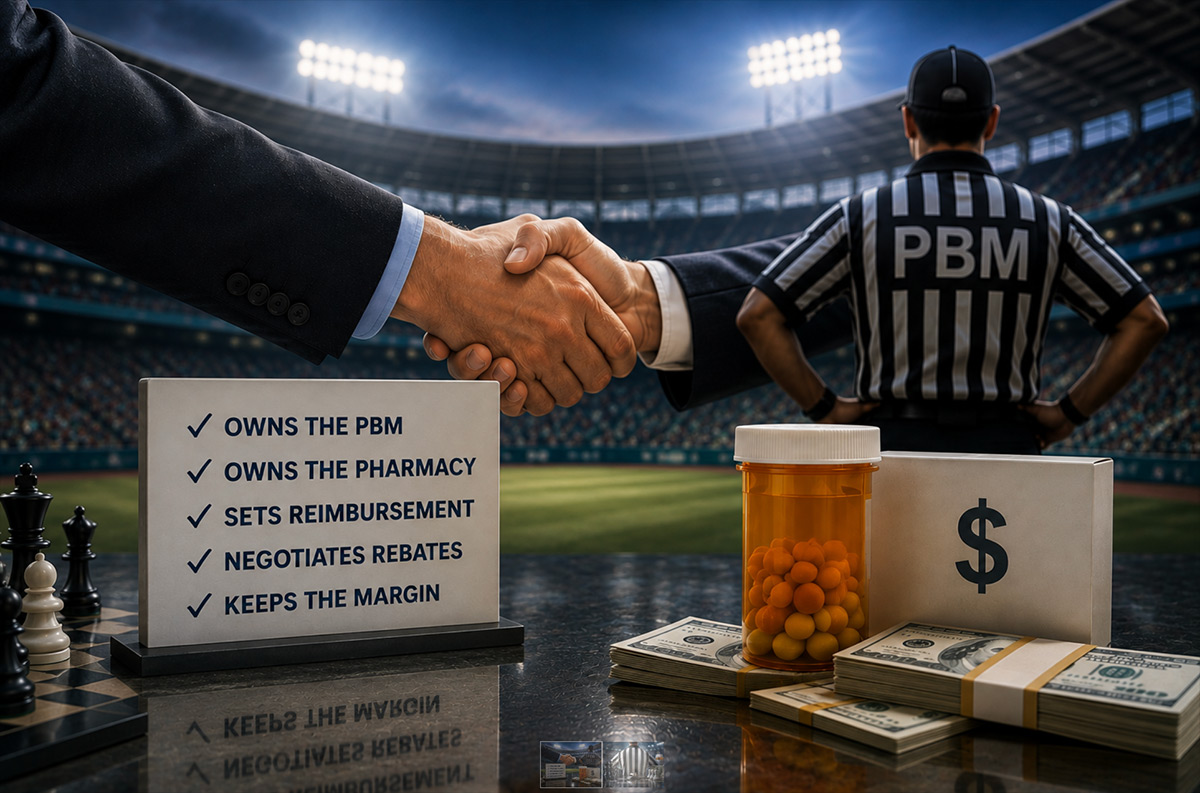
The premise that plan sponsors are “saving” by negotiating with their PBM on specialty pharmacy deserves more scrutiny than it typically gets. Because the entity you’re negotiating with (the one you’re hoping will pass through the right number, steer to the right pharmacy, and structure the right formulary) is also the entity that owns the pharmacy, collects the dispensing margin, and sets the reimbursement rates. That’s not a negotiating partner. That’s a referee who bought the stadium.
The Numbers Behind the Conflict
This isn’t abstract. Fein’s own Drug Channels Institute data makes the structure visible. For 2025, the three largest specialty pharmacies accounted for two-thirds of total prescription revenues from pharmacy-dispensed specialty drugs – and all three are owned by vertically integrated organizations that also own a PBM. The Big Three process about 80% of all equivalent prescription claims, and the internal economics are striking: for 2024, 60% of Optum Rx’s revenues came from affiliated businesses within UnitedHealthcare Group. At CVS Health, $53 billion of the combined $263 billion in revenues at its pharmacy and PBM segments reflected transactions between the two segments.
Read that again. More than half of CVS Health’s pharmacy-and-PBM revenue is the company paying itself. This is the entity plan sponsors are counting on to find them savings.
What “Negotiating with Your Pharmacy” Actually Means
When a payor sits down to negotiate specialty pharmacy arrangements with a major PBM, here is what it is actually negotiating: the terms under which a company that controls the formulary will steer patients to a pharmacy that it also owns, reimburse that pharmacy at rates it also controls, and pass through a portion of the manufacturer rebates it negotiates – a portion that, according to PSG’s data, nearly half of employers on specialty drugs cannot fully verify.
The FTC’s investigation revealed differences in reimbursement rates between PBM-affiliated pharmacies and unaffiliated ones, with affiliated pharmacies receiving more favorable terms. Research published in 2025 found that the share of prescriptions filled at PBM-owned pharmacies was substantially higher among patients enrolled in PBM-owned health plans – not because those pharmacies were chosen by patients, but because the system was built to funnel volume there.
This is the arrangement employers describe as their cost-control strategy.
The Conflict Isn’t a Glitch. It’s the Architecture.
There’s a tendency in benefits discussions to treat vertical integration as a background fact – uncomfortable, maybe, but not really the point. The point is supposed to be: are we getting our rebates, are our contracts competitive, are we benchmarked correctly?
But the conflict of interest is the point. You cannot negotiate a favorable specialty pharmacy arrangement with an entity whose profitability depends on the arrangement staying unfavorable to you. That’s not pessimism – it’s how incentives work. When OptumRx has its own specialty pharmacy, when CVS Caremark can steer patients to CVS pharmacies, when Express Scripts promotes Accredo for specialty drugs – the question of whether any given negotiation produces genuine savings for the plan is structurally compromised before it begins.
And the employers who can’t account for their specialty rebates – PSG’s 46% – aren’t losing a negotiation. They walked into a negotiation where the other party was always going to win on multiple dimensions simultaneously.
A Different Question for Plan Sponsors
The conversation Adam Fein’s data should prompt isn’t just “are we getting our rebates?” It’s: why have we organized our entire specialty cost management strategy around a negotiation with a counterparty that profits from the complexity of that negotiation?
At Ethicos Health, we think the better question is whether the specialty drug is working for the patient taking it. That’s a question your PBM’s specialty pharmacy has no financial interest in answering – they get paid the same whether the drug produces a clinical result or doesn’t. Our platform certifies and re-certifies specialty medications against real outcomes for real members. The savings aren’t negotiated. They emerge from not paying for treatments that aren’t working.
That’s a different model entirely. And notably, it’s one where the entity measuring the outcome doesn’t also own the pharmacy dispensing the drug.